
How Much Time Does Your FM Team Spend Chasing Contractors and Compliance Paperwork?
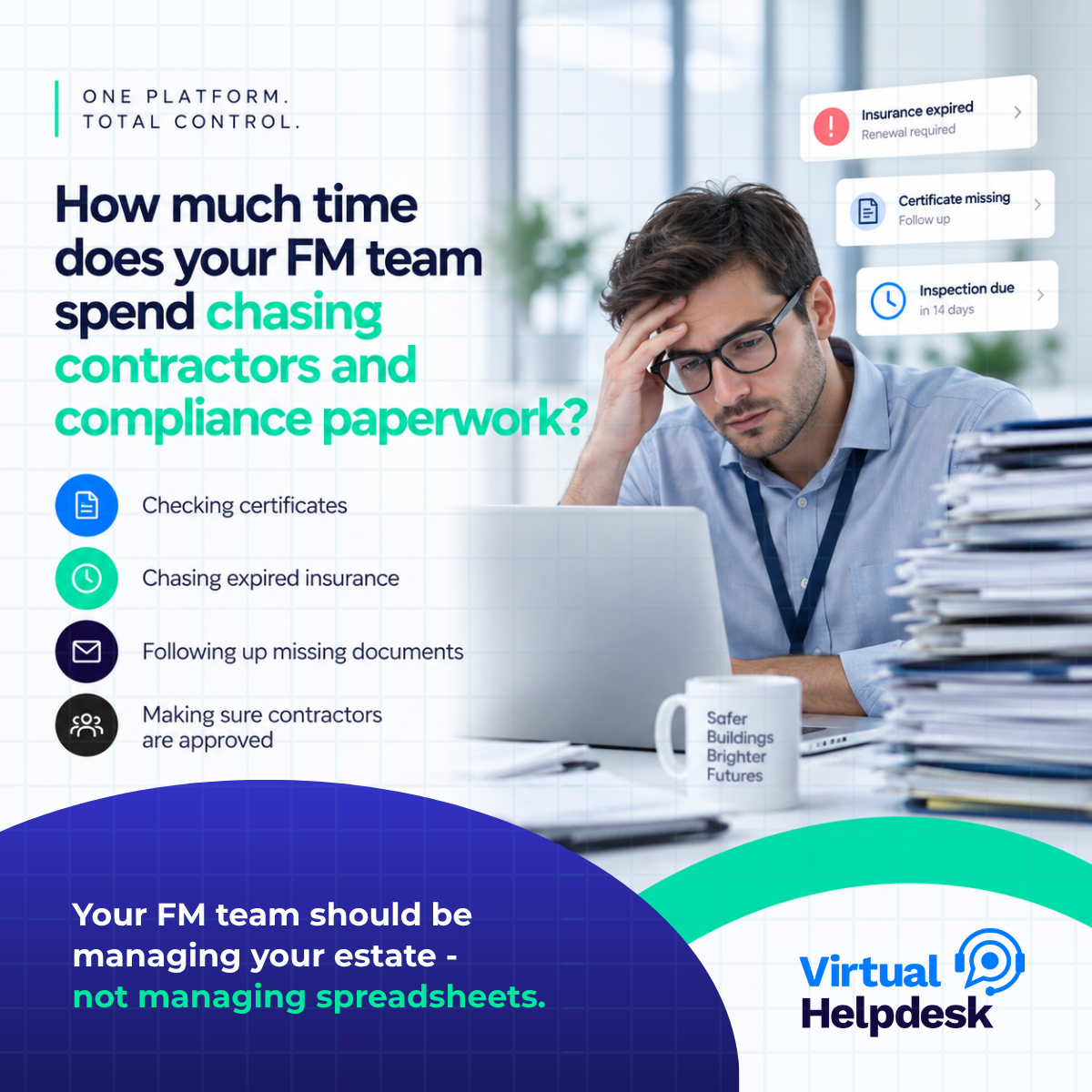
Facilities Management teams are under constant pressure to keep buildings safe, compliant and operational.
But how much of your team’s working week is actually spent managing facilities — and how much is spent chasing paperwork?
Emails asking contractors for updated insurance certificates. Spreadsheets tracking expiry dates. Phone calls following up missing documents. Searching folders for compliance records. Checking whether contractors are approved before they arrive on site.
Individually, these tasks might only take a few minutes.
Across hundreds of contractors, assets and multiple sites, however, those minutes quickly become hours.
And the problem isn’t just lost productivity. When compliance information is fragmented across spreadsheets, inboxes and different systems, it becomes much harder to answer a far more important question:
Are we actually compliant right now?
The hidden administrative burden of contractor management
Managing contractors involves far more than raising a job and waiting for it to be completed.
Facilities teams may need to verify insurance, certifications and accreditations, check expiry dates, maintain contractor records and ensure the right documentation is available before work begins.
When these processes rely heavily on manual administration, somebody has to keep everything moving.
That often means an FM or compliance professional becomes the person responsible for remembering which certificate expires next month, which contractor hasn’t responded and which spreadsheet needs updating.
It’s valuable time being spent on administration rather than improving the performance of the estate.
There’s also a scalability problem.
Managing compliance manually may feel achievable with ten contractors. What happens when you’re responsible for 50? Or 200? What happens when those contractors are working across dozens or even hundreds of locations?
The complexity grows quickly.
Spreadsheets don’t chase people
Spreadsheets are useful tools, but they don’t automatically solve the underlying problem.
They don’t ask a contractor to upload a new certificate when one approaches expiry. They don’t automatically alert the right person when documentation is missing. And they don’t necessarily give senior management an immediate view of compliance across an entire estate.
Instead, the process depends on people remembering to check.
That’s where risk begins to creep in.
A contractor’s insurance expires. A certificate hasn’t been uploaded. An inspection becomes overdue. A document exists somewhere, but nobody can immediately find it.
The issue isn’t necessarily that the FM team isn’t doing its job.
The issue is that the system is creating unnecessary work.
What would your team do with that time back?
Imagine removing a significant proportion of that manual administration.
Instead of searching through spreadsheets and inboxes, your team has one place to see contractor and compliance information.
Instead of manually checking dates, upcoming expirations and compliance issues are visible.
Instead of repeatedly chasing documentation, automated processes help keep records current.
Suddenly, your FM team can spend more time on the activities where their expertise delivers greater value: improving asset performance, reducing downtime, planning preventative maintenance, controlling costs and creating better environments for building users.
It’s not simply about saving administrative time.
It’s about allowing skilled FM professionals to focus on Facilities Management.
From chasing compliance to seeing it
There’s another important difference between manually managing compliance and having real-time visibility of it.
Confidence.
If a senior leader walked into your office today and asked:
“Can you show me that every contractor currently working across our estate is compliant?”
How quickly could you answer?
Could you demonstrate it immediately?
Or would somebody need to open several spreadsheets, search through emails, contact colleagues and start compiling information?
For organisations operating complex or highly regulated estates, that distinction matters.
Facilities and Estates leaders need to be able to see where risks exist, identify what requires attention and demonstrate that appropriate controls are in place.
The goal should be to move from “We think we’re compliant” to “We can show you we’re compliant.”
One platform. Greater visibility. Less chasing.
Virtual Helpdesk brings contractor oversight, compliance management, assets and facilities management together within one CAFM platform.
Rather than relying on disconnected spreadsheets, inboxes and manual processes, FM teams can create a central source of information across their estate.
That means greater visibility of contractor compliance, documentation and expiry dates — and less time spent finding and chasing information.
For Facilities and Estates teams managing multiple buildings, assets and contractors, the impact can be significant.
Fewer manual processes.
Better visibility.
Stronger compliance oversight.
More time to focus on the estate itself.
So perhaps the question isn’t simply:
How much time does your FM team spend chasing contractors and compliance paperwork?
It’s:
What could they achieve if they didn’t have to?
If your FM team is spending too much time chasing information rather than acting on it, discover how Virtual Helpdesk can help you take control of contractors, compliance and your wider estate.
Related News & Blogs



Let’s Get Started
Smart Facility Management Starts Here
Take control of your facilities with Virtual Helpdesk’s innovative CAFM solution. From compliance to maintenance, we’ve got you covered.
Location
info@virtual-helpdesk.com
Franklins House, Wesley Lane, Bicester, OX26 6JU

Subscribe
Keep up to date with our latest product releases and news.