
Why Financial Visibility Is Essential for Smarter Facilities Management
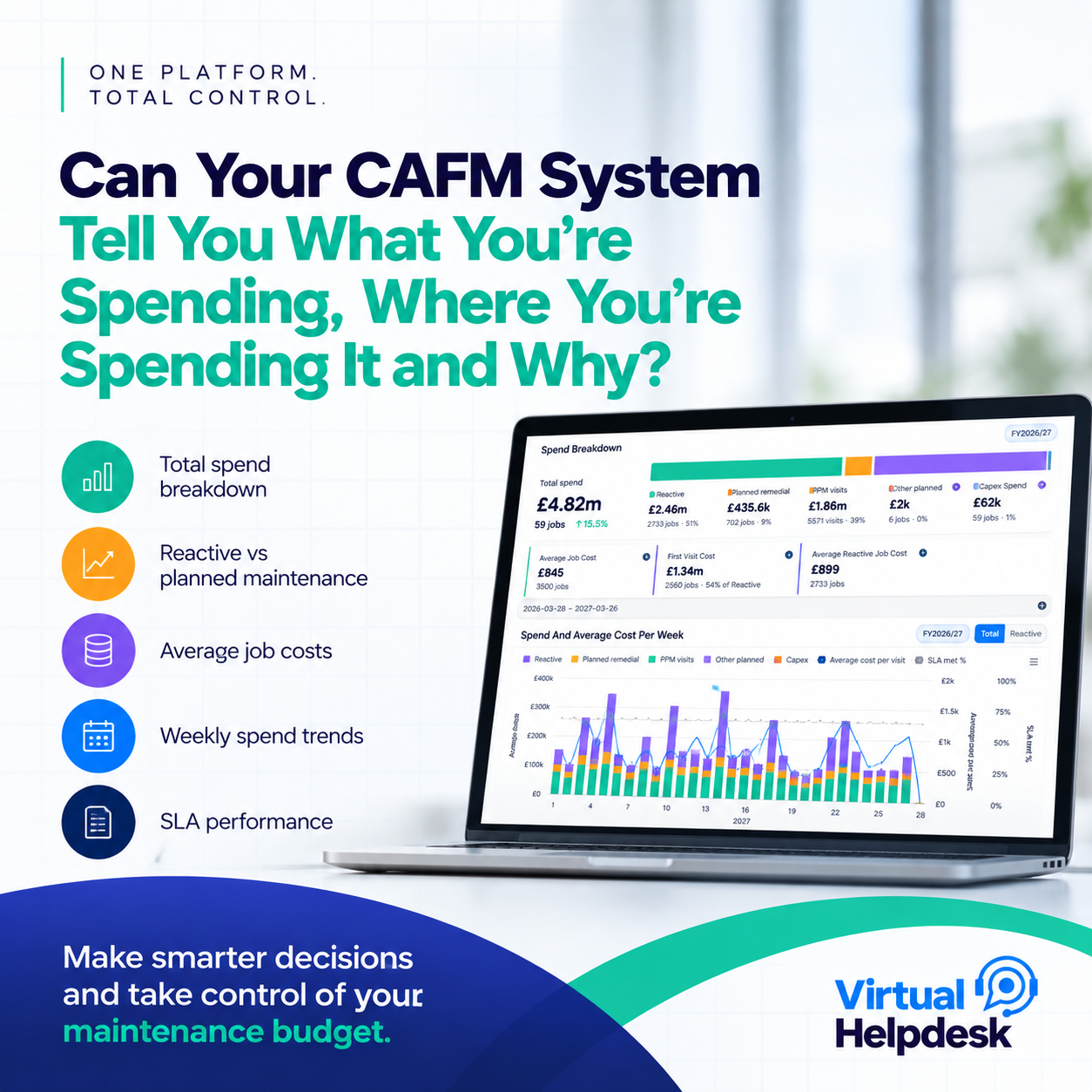
If you can’t see where your maintenance budget is going, how can you be confident you’re spending it effectively?
For Finance Directors, Facilities Managers and senior leadership teams, controlling the cost of managing buildings, assets and maintenance operations has never been more important.
Rising operational costs, ageing assets, increasing compliance obligations and pressure on budgets mean that organisations need more than a system that simply records maintenance jobs.
They need accurate, accessible financial information that helps them understand expenditure, identify inefficiencies and make better decisions.
This is where a modern Computer-Aided Facilities Management (CAFM) system should deliver real value.
At Virtual Helpdesk, we believe financial visibility should be a fundamental part of effective facilities management, not an additional reporting exercise.
Our financial analytics dashboard brings maintenance expenditure, cost trends, job performance and operational information together in one place.
The result? Greater transparency, improved financial control and more informed decision-making across your entire estate.
1. Understanding Where Your Maintenance Budget Is Going
One of the biggest challenges in facilities management is understanding exactly how money is being spent.
Maintenance expenditure is rarely straightforward. Costs are spread across reactive repairs, planned remedial works, preventative maintenance, capital expenditure and contractor activities.
Without a consolidated view, understanding the true financial position can involve extracting information from different systems, reconciling spreadsheets and manually producing reports.
This takes time and increases the risk of important information being overlooked.
Virtual Helpdesk changes that.
Our financial dashboard provides a clear breakdown of expenditure across key maintenance categories, including:
- Reactive maintenance
- Planned remedial works
- Planned Preventative Maintenance (PPM)
- Other planned maintenance
- Capital expenditure (Capex)
Instead of simply seeing a total expenditure figure, decision-makers can understand what is driving that expenditure.
Why does this matter?
Because knowing that an organisation has spent £1 million on maintenance is not nearly as useful as understanding why it was spent, where it was spent and whether that expenditure could have been avoided.
This level of visibility supports better budgeting, stronger financial governance and more effective allocation of resources.
2. Reactive vs Planned Maintenance: Understanding the True Cost
Reactive maintenance is an unavoidable part of facilities management.
Buildings develop faults, equipment fails and unexpected issues require attention.
However, a consistently high proportion of reactive maintenance expenditure can indicate deeper operational challenges.
These might include ageing assets, ineffective preventative maintenance schedules, recurring equipment failures or insufficient investment in asset replacement.
Consider the financial analytics shown in our Virtual Helpdesk dashboard.
The example illustrates approximately:
- £2.46 million in reactive maintenance expenditure
- £1.86 million in PPM expenditure
- £435,600 in planned remedial works
Reactive maintenance accounts for approximately 51% of the total expenditure shown.
That is an important figure for any Facilities Manager or Finance Director to understand.
It raises valuable questions.
Are particular assets repeatedly failing? Is preventative maintenance being completed at the right intervals? Could earlier intervention reduce expensive reactive repairs? Would replacing certain assets be more economical than continuing to repair them?
Without reliable financial and operational data, these questions are difficult to answer confidently.
With Virtual Helpdesk, organisations can begin identifying patterns and making evidence-based decisions about their maintenance strategies.
The objective isn’t simply to spend less. It’s to spend more intelligently.
3. Understanding the Average Cost of Maintenance Jobs
Knowing how much maintenance costs in total is important.
Understanding how much individual maintenance activities cost can be even more valuable.
Virtual Helpdesk provides financial metrics including average job cost and average reactive job cost.
For example, the dashboard illustrates:
- £845 average job cost
- £899 average reactive job cost
These figures help establish useful benchmarks for ongoing financial performance.
A Facilities Manager can monitor whether job costs are increasing over time.
A Finance Director can identify expenditure trends that may require further investigation.
An Asset Manager can assess whether particular equipment is becoming increasingly expensive to maintain.
Over time, this information can support more effective contractor management, maintenance planning and lifecycle investment decisions.
Why is this important?
Because small increases in maintenance costs can have a substantial cumulative impact across a large estate.
If an organisation manages thousands of maintenance jobs annually, even relatively modest improvements in cost efficiency can represent meaningful financial savings.
Having the data available is the first step towards identifying those opportunities.
4. Monitoring Maintenance Expenditure Week by Week
Annual budgets provide an essential financial framework.
But waiting until the end of a quarter or financial year to understand maintenance expenditure can mean problems are identified too late.
Financial performance needs to be monitored throughout the year.
The Virtual Helpdesk financial analytics dashboard provides a weekly view of maintenance expenditure, allowing users to visualise spending patterns over time.
This makes it easier to identify unusual expenditure increases, compare reactive and planned maintenance costs, understand the impact of maintenance programmes and monitor how spending develops against operational activity.
For example, a significant increase in expenditure during a particular week might be linked to a major equipment failure, a programme of planned works or several expensive reactive repairs.
Rather than discovering this months later, management teams can investigate the reasons much sooner.
The value is not simply having a graph. It is having the information needed to ask the right questions at the right time.
This supports a more proactive approach to financial management.
5. Linking Financial Performance with Contractor Accountability
Contractor management is a critical part of facilities management.
Organisations need confidence that external service providers are delivering work efficiently, meeting agreed standards and providing value for money.
However, cost alone does not tell the whole story.
A contractor may appear inexpensive but consistently miss service-level agreements, require repeat visits or fail to resolve issues effectively.
Another contractor may charge more but deliver stronger first-time resolution rates and better overall outcomes.
This is why financial and operational performance should be considered together.
Virtual Helpdesk’s analytics dashboard brings expenditure information alongside operational measures, including SLA performance and first-visit costs.
This provides valuable context when reviewing maintenance delivery.
It helps management teams investigate questions such as:
- Are we achieving value for money from our contractors?
- How much are we spending on initial visits?
- Are service-level agreements being achieved?
- Are maintenance costs increasing without corresponding improvements in service?
- Where should we focus our contractor performance reviews?
Effective contractor management is about accountability, performance and value — not simply choosing the lowest price.
6. Why Finance Directors Need Visibility of Facilities Expenditure
Facilities management is often one of an organisation’s most significant areas of operational expenditure.
Yet Finance Directors may not always have immediate access to the detailed information needed to understand what is driving those costs.
Financial reports may show how much has been spent without explaining the operational reasons behind that expenditure.
This creates a disconnect between financial oversight and facilities management activity.
A modern CAFM system can help bridge that gap.
With accessible financial analytics, Finance Directors can gain greater confidence in maintenance expenditure, understand cost drivers, identify budget pressures earlier and support more informed investment decisions.
It also creates opportunities for more productive conversations between finance and facilities teams.
Rather than simply asking why maintenance costs have increased, organisations can examine the underlying operational information and determine whether the expenditure was necessary, avoidable or part of a longer-term improvement strategy.
Financial visibility transforms facilities management from a perceived cost centre into a more transparent, accountable business function.
7. Supporting Better Asset Lifecycle Decisions
Every asset has a lifecycle.
From installation and commissioning through maintenance, repair and eventual replacement, assets create costs throughout their operational life.
One of the most difficult decisions for Asset Managers is determining when continued repair is no longer financially sensible.
An ageing asset might still function, but if it requires frequent reactive maintenance, the total cost of ownership may be increasing significantly.
Without reliable maintenance records and expenditure information, replacement decisions can become reactive rather than strategic.
Combining financial analytics with asset management information helps organisations build a clearer picture of asset performance.
This supports decisions about whether to continue repairing equipment, increase preventative maintenance, prioritise capital investment or plan for replacement.
It also strengthens the business case for investment.
Rather than relying on assumptions, Asset Managers can use maintenance history and cost information to demonstrate why replacement may be justified.
Better asset data leads to better investment decisions and better long-term financial planning.
8. Financial Control and Compliance Go Hand in Hand
Facilities management is not just about managing costs.
It is also about maintaining safe, compliant and operationally effective buildings.
Organisations have responsibilities relating to statutory inspections, maintenance activities, asset safety and the management of contractors.
Reducing expenditure without understanding the operational and compliance implications can introduce significant risks.
For example, deferring essential maintenance may appear to deliver short-term savings but could contribute to equipment failures, operational disruption or compliance concerns later.
This is why financial decisions should be informed by reliable maintenance and compliance information.
Virtual Helpdesk brings together financial management, asset information, planned maintenance and compliance management within one CAFM environment.
This supports a more balanced approach to decision-making, where expenditure can be considered alongside operational requirements and compliance obligations.
For organisations managing complex estates, connected records can also support stronger audit readiness and the principles of the Golden Thread by helping maintain accessible, traceable information about buildings, assets and maintenance activity.
The goal is not to minimise maintenance expenditure at any cost. It is to manage expenditure responsibly while protecting buildings, people and operational performance.
9. Moving Away from Spreadsheets and Manual Reporting
Many facilities teams still rely heavily on spreadsheets to monitor expenditure and produce management reports.
Although spreadsheets have their place, they can create challenges when information is spread across multiple files, teams and systems.
Common problems include duplicated data, inconsistent reporting, outdated information and time-consuming manual reconciliation.
The result is that highly skilled Facilities Managers can spend valuable time preparing reports instead of acting on the information within them.
A connected CAFM system reduces the need to manually assemble information from multiple sources.
Virtual Helpdesk makes financial analytics accessible through a central dashboard, allowing authorised users to review expenditure and operational trends without repeatedly building reports from scratch.
This can save administrative time, improve consistency and make financial information easier to share with relevant stakeholders.
Less time gathering data. More time using it to make informed decisions.
10. From Reporting What Happened to Improving What Happens Next
Perhaps the greatest benefit of financial analytics is the opportunity to move beyond historical reporting.
Traditional reporting often focuses on what has already happened.
How much did we spend last month? How many maintenance jobs were completed? Did we exceed our budget?
These are important questions, but they should be the starting point rather than the end of the conversation.
When financial analytics are combined with maintenance history, asset information and contractor performance, organisations can begin asking more valuable questions.
Why are costs increasing? Which assets are creating the greatest financial pressure? Could a different maintenance strategy improve outcomes? Where would additional investment deliver the greatest long-term benefit?
These are the questions that support smarter facilities management.
Financial dashboards do not make decisions for organisations.
They provide the visibility and evidence needed to make those decisions with greater confidence.
Can Your CAFM System Do This?
<escape></escape>
Virtual Helpdesk financial analytics: providing visibility of maintenance expenditure, spending trends and operational performance in one place.
If your current CAFM system cannot clearly show where your maintenance budget is going, how costs are changing and what is driving expenditure, it may be time to ask whether it is providing the financial oversight your organisation needs.
Facilities management software should do more than record jobs and store asset information.
It should help organisations understand performance, control costs, manage risk and make better decisions.
With Virtual Helpdesk, financial analytics sit alongside the wider capabilities needed to manage modern facilities and estates.
From asset and estate management to contractor oversight, compliance and planned preventative maintenance, Virtual Helpdesk brings essential information together in one cloud-based CAFM system.
Everything you need, in one CAFM system.
Better visibility. Greater control. More confident decisions.
Discover how Virtual Helpdesk can help your organisation take greater control of maintenance expenditure and facilities performance.
Related News & Blogs



Let’s Get Started
Smart Facility Management Starts Here
Take control of your facilities with Virtual Helpdesk’s innovative CAFM solution. From compliance to maintenance, we’ve got you covered.
Location
info@virtual-helpdesk.com
Franklins House, Wesley Lane, Bicester, OX26 6JU

Subscribe
Keep up to date with our latest product releases and news.